What to carry with you
- Curl pattern is only one variable in how hair behaves.
- Porosity, density, strand diameter, and weather help explain product and routine needs.
- Observation beats forcing your hair into a fixed category.
Overview
Natural hair structure is defined by elliptical follicle geometry, curvature along the fiber shaft, cuticle layer integrity, and cortical protein alignment. Because coiled strands feature structural turns where mechanical stress concentrates, textured hair requires specialized handling to preserve moisture, prevent cuticle wear, and minimize fiber breakage across all hair types.
The strand is a fiber
A hair strand is a keratin fiber formed in a follicle. The visible shaft is no longer living tissue, which is why care focuses on preserving its condition rather than healing it in the way skin heals. The outer cuticle helps shield the inner cortex. Friction, chemical processing, high heat, and repeated tension can wear that protective surface down over time.
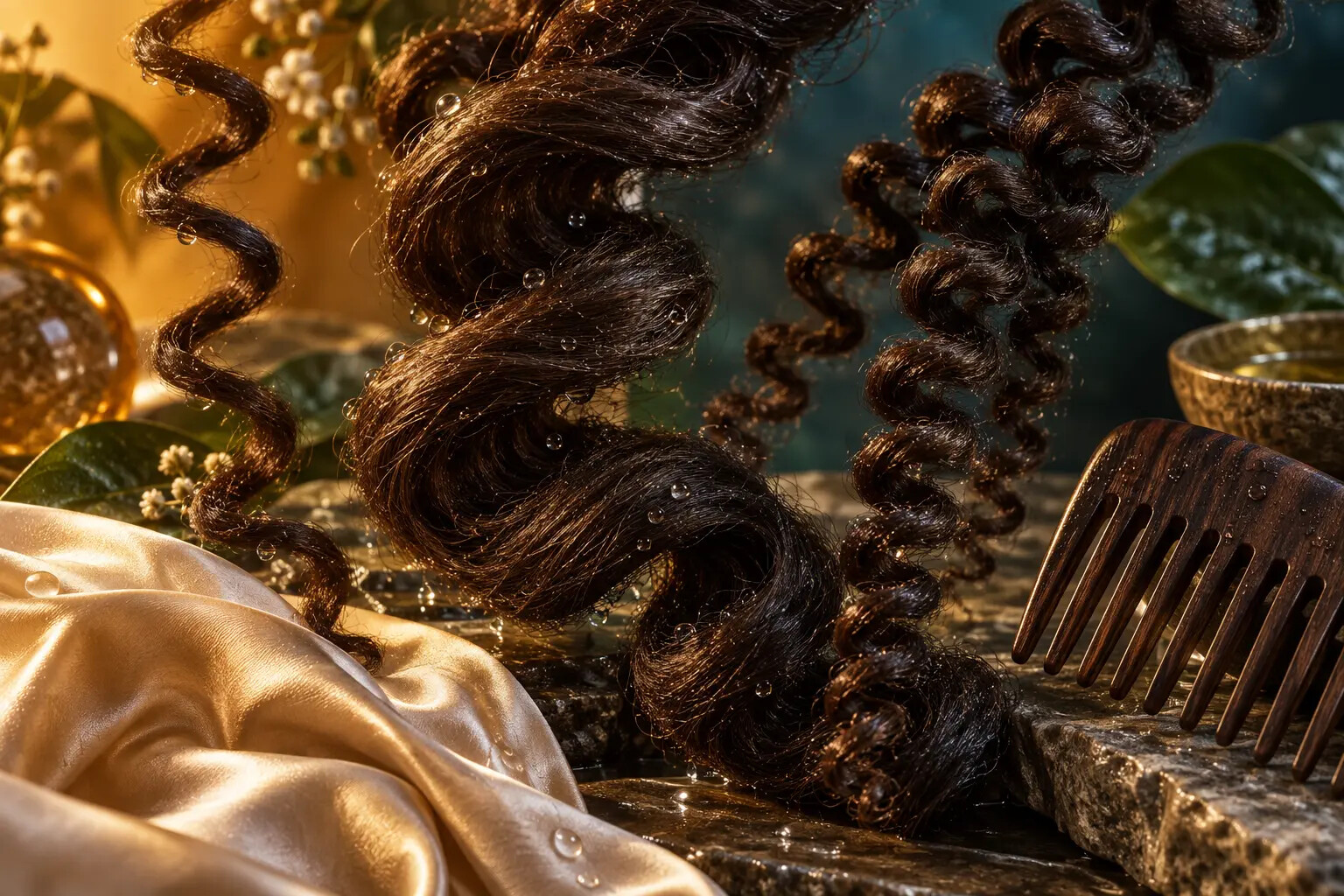
Curly and coiled fibers bend along their length. Those turns create beauty and volume, but they also create points where mechanical stress can concentrate. Natural scalp oils may travel less evenly along a curved strand, which can leave ends feeling drier. That does not make textured hair defective; it means handling and conditioning choices matter.
What curl typing can—and cannot—do
Curl charts give people a shared visual vocabulary, but they are not a diagnosis or a complete care plan. Many heads contain several visible patterns. Pattern can also appear different depending on length, humidity, product, damage, shrinkage, and styling.
Use a type label as a conversation starter, not a rulebook. Two people who both identify with the same curl family may need very different routines because their density, strand width, porosity, scalp condition, and lifestyle differ.
The four observations worth tracking
Porosity describes how readily hair takes in and loses water, but home float tests are unreliable. A more useful approach is to observe how quickly thoroughly wetted hair absorbs product, how long it takes to dry, and how it responds after conditioning. Density describes how much hair grows across an area; strand diameter describes whether individual fibers feel fine, medium, or coarse.
- Notice how the hair feels before, during, and two days after wash day.
- Track whether buildup appears quickly or moisture seems to disappear quickly.
- Adjust one variable at a time so you can tell what actually helped.
Build a routine from behavior
If hair tangles easily, prioritize slip, sectioning, and slower detangling. If fine strands collapse under heavy layers, use less product. If the scalp becomes uncomfortable beneath long-wear styles, shorten the interval. The routine should respond to the person, not to an internet template.
The simplest useful system is cleanse, condition, handle gently, style without pain, and reassess. Texture knowledge is valuable when it reduces confusion—not when it creates another standard your hair is expected to obey.
Frequently asked questions
What causes hair strands to curl or coil?
Hair shape is determined by the oval or asymmetrical shape of the hair follicle beneath the scalp, as well as uneven cell distribution as the keratin fiber grows.
What is hair porosity and why does it matter?
Porosity measures how easily water and products pass through the outer cuticle layer into the cortex. Understanding your hair response to water helps guide conditioner choices and moisture retention strategies.
Why is hair typing (like 4C or 3B) incomplete on its own?
Curl classification only describes visual shape. It omits critical functional variables like strand diameter (fine vs. coarse), follicle density, porosity, scalp oil production, and damage history.
Sources & further reading
Sources support the educational statements in this guide. Product and routine choices remain individual.
American Academy of Dermatology: Black hair—tips for everyday care American Academy of Dermatology: How to stop damaging your hairThis guide is educational and cannot diagnose hair or scalp conditions. Seek professional care for sudden or patchy loss, pain, sores, severe scaling, or persistent symptoms.